Scrolling Through the Ruins: What the Ancient Stoics Knew About Living in a World That Never Stops Talking
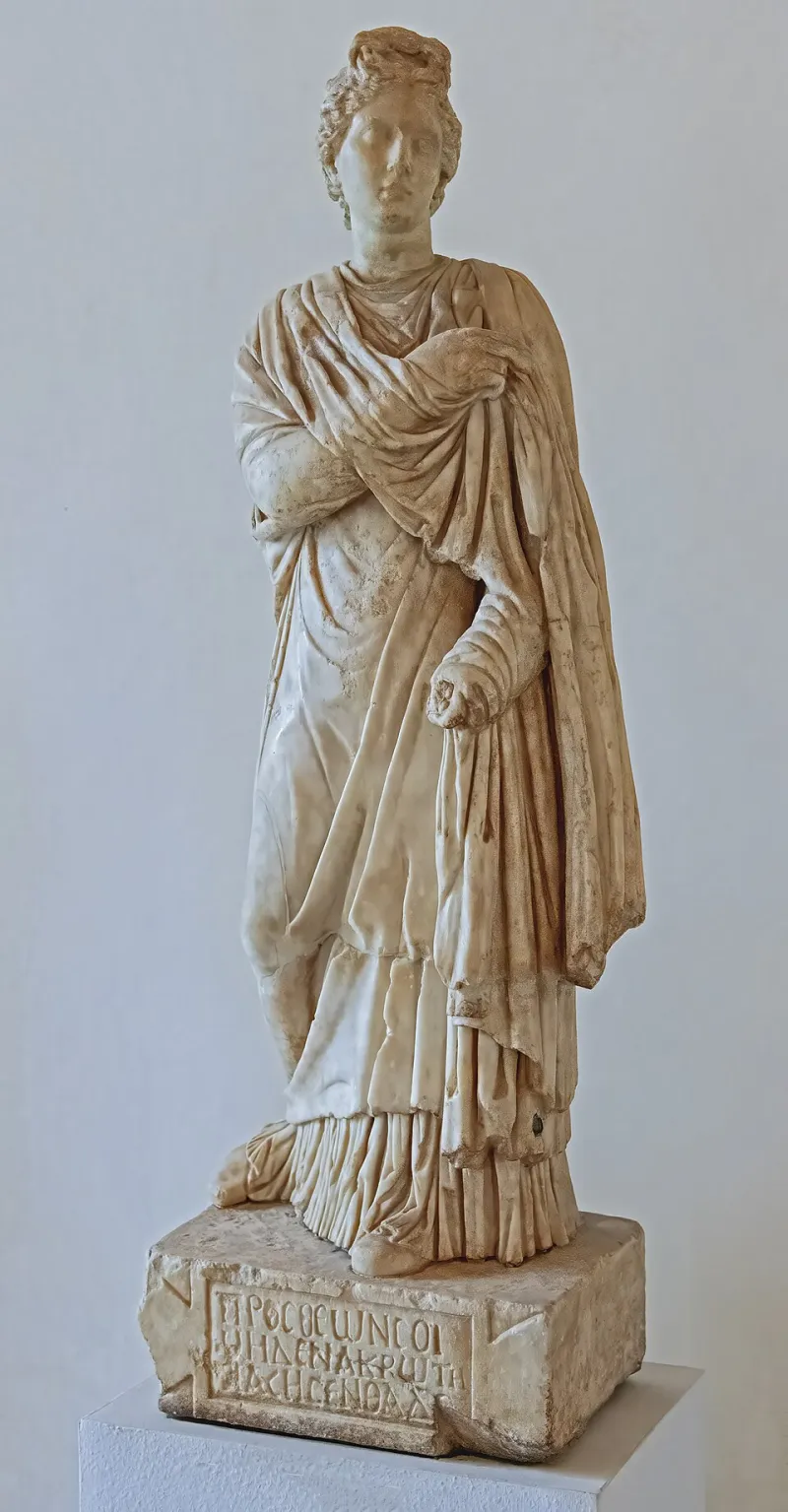
Photo: Didier Descouens, Public domain, via Wikimedia Commons
Somewhere in the second century AD, a man who commanded the largest empire on earth sat down each evening to write notes to himself. Not dispatches. Not decrees. Personal reflections—arguments he was making with himself about how to live, how to lead, how to remain a decent human being under conditions that would have broken most people entirely.
His name was Marcus Aurelius. His private journal, never intended for publication, survives as Meditations—one of the most quietly devastating books in the Western philosophical tradition. And it begins, characteristically, not with proclamations of imperial wisdom but with a list of debts: what he learned from his grandfather, his father, his teachers. Gratitude before philosophy. Humility before authority.
We are not Romans. We do not govern provinces or command legions. But we face, in our own register, a version of the same problem Marcus was writing his way through: how to think clearly, act decently, and find meaning in the middle of circumstances that conspire, hourly, to prevent all three.
The Noise That Preceded Our Noise
There is a temptation, when we discuss distraction and fragmented attention, to treat these as uniquely modern problems—the inevitable byproducts of smartphones and social media algorithms. This temptation is understandable but historically shortsighted.
Lucius Annaeus Seneca, writing in Rome around 65 AD, complained in terms that would not be out of place in a 2024 newsletter about digital wellness. "I cannot for the life of me see that quiet and busy-ness are as incompatible as people imagine," he wrote to his friend Lucilius. "Retire into yourself as much as you can." Elsewhere, he noted that the man who follows a crowd will find himself carried somewhere he never intended to go.
Epictetus, born a slave in what is now Turkey, taught philosophy in a rented room and owned, by his own account, almost nothing. He had experienced, at the most visceral level possible, the difference between what is within a person's control and what is not. His entire philosophical project was organized around that distinction. "Make the best use of what is in your power," he wrote, "and take the rest as it happens."
These three figures—Marcus, Seneca, Epictetus—represent the apex of what we call Stoicism, a school of thought founded in Athens around 300 BC. And while the academic details of Stoic metaphysics are largely the province of specialists, the practical core of their teaching is available to anyone willing to sit with it. It is also, for reasons that deserve examination, startlingly applicable to the specific predicament of American life in the early twenty-first century.
The Dichotomy of Control and the American Anxiety Machine
Epictetus identified what he called the dichotomy of control as the foundational insight of the examined life. Some things are up to us—our judgments, our intentions, our responses, our values. Everything else is not up to us—our reputation, other people's opinions, the economy, the news cycle, the outcome of elections, the behavior of our colleagues, the algorithm that decides whether our work is seen.
This sounds simple. It is, in practice, enormously difficult. American culture has spent the better part of a century training its citizens to feel responsible for—and anxious about—precisely the things that are not within their control. Career success, measured in titles and compensation. Social standing, measured in followers and engagement. Physical appearance, measured against standards that shift with every media cycle. The result is a population that is, by almost any clinical measure, among the most anxious in the developed world.
The Stoic response to this condition is not indifference. It is clarification. Before you spend energy worrying about something, ask: is this actually within my control? If yes, act. If no, release it—not because it does not matter, but because your anxiety about it changes nothing except the quality of your own mind.
This is not passive resignation. Marcus Aurelius was one of the most active and engaged rulers in Roman history. Seneca served as an advisor to Nero during some of the most volatile years of the empire. Epictetus trained students who went on to positions of considerable influence. The Stoics were not quietists. They were engaged in the world. But they refused to allow the world's chaos to colonize their interior lives.
Social Media and the Stoic Mirror
Consider the architecture of a modern social media platform through a Stoic lens. The platform is designed, at the engineering level, to maximize engagement—which, in practice, means maximizing emotional arousal. Outrage, envy, anxiety, and tribal solidarity are among the most reliable engagement drivers. The algorithm does not reward equanimity. It penalizes it.
Seneca wrote, with what feels like eerie foresight: "There is nothing so ruinous to good character as to idle away one's time at a show—for it is then, through the medium of entertainment, that vices creep into one's soul with greater ease."
He was describing the Roman games. He might as well have been describing the For You page.
The Stoic framework does not require that we abandon technology or retreat from public life. But it does require that we interrogate our relationship to the attention economy with the same rigor we might apply to any other force that shapes our judgment. Is the time I spend on this platform making me wiser, more compassionate, more effective? Or is it making me more reactive, more envious, more certain that my outrage is the truest thing about me?
These are not rhetorical questions. They are the questions Marcus was asking himself in his tent on the Danube frontier, surrounded by war and plague, trying to figure out how to remain a human being worth the title.
The Practice, Not the Theory
One of the most distinctive features of Stoicism, compared to many other philosophical traditions, is its insistence on practice. Philosophy, for the Stoics, was not primarily an intellectual exercise. It was a set of daily habits—a regimen for the mind analogous to what physical training is for the body.
Seneca recommended the evening review: before sleep, run through the day's events. Where did you act well? Where did you fall short? What would you do differently? Not as self-punishment, but as calibration. The goal was not guilt but improvement—the slow, patient work of becoming someone whose actions align with their stated values.
Marcus practiced what scholars call negative visualization—the deliberate contemplation of loss. Before leaving for the day, he would remind himself that the people he loved might not be there when he returned. Not morbidly, but as a discipline of gratitude. If you know something is temporary, you attend to it differently. You are less likely to take it for granted. You are more likely to be present for it.
Epictetus recommended a kind of internal pause—a gap between stimulus and response—in which the practitioner asks: What is this, really? And what is the appropriate response to it? In an age of instant reaction, instant publication, and instant consequences, the cultivation of that pause may be the single most countercultural act available to an American in 2025.
An Ancient Compass for an Unmoored Age
The Stoics were not optimists in the contemporary American sense. They did not believe that everything would work out, that the universe was fundamentally benevolent, or that positive thinking could reshape reality. What they believed was more austere and, in the end, more sustaining: that the quality of a life is determined not by what happens to a person, but by what a person does with what happens to them.
This is, in its own quiet way, a radical claim. It removes the locus of meaning from the external world—from income and status and the opinions of strangers—and places it squarely in the interior life. It says that the person who tends their own character with care and consistency has something that no algorithm can amplify or diminish, no market can price, and no news cycle can render obsolete.
The Stoics called this eudaimonia—a word usually translated as happiness but more accurately rendered as flourishing. It is not a feeling. It is a condition. And it is available, they insisted, to anyone willing to do the work.
Two thousand years on, in a country saturated with noise and hungry for meaning, that offer still stands.