The Architecture of Avoidance: What We Build When We Refuse to Be Still

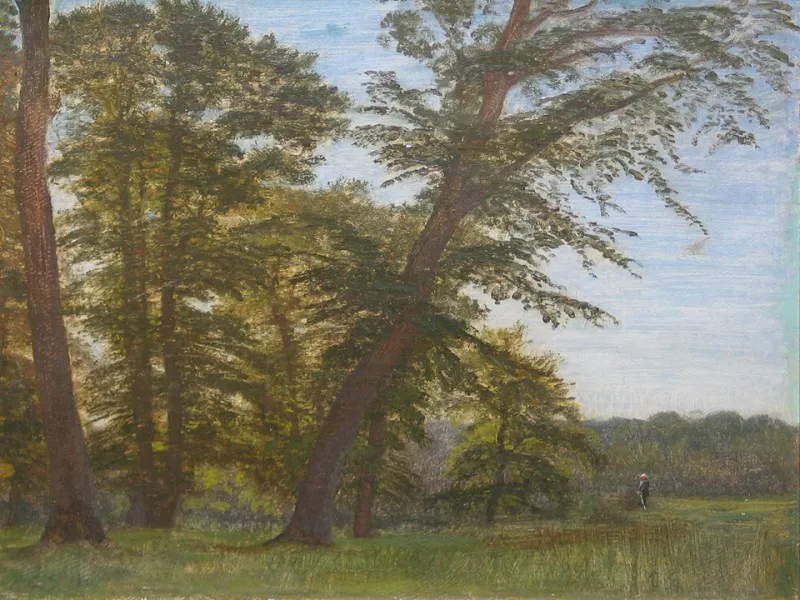
Photo: Vyshnavi medicharla, CC0, via Wikimedia Commons
Somewhere in the Yucatán, a civilization spent centuries quarrying limestone, dragging it across jungle terrain, and stacking it with extraordinary precision toward the sky. The pyramids of the ancient Maya were, among other things, theological statements—assertions of cosmic order, of humanity's place in a universe that could otherwise seem indifferent and vast. They were, in every sense, impressive. They were also, at some level, an answer to a question that the jungle silence made impossible to ignore.
We are still building pyramids. We have simply changed the materials.
The contemporary American life, examined with a certain kind of patience, reveals itself as an elaborate construction project. We fill our hours with meetings that could be emails, with social obligations that exhaust rather than nourish, with the restless consumption of content that evaporates almost as soon as it is encountered. We optimize our productivity and then optimize our leisure. We curate our identities across multiple platforms with a care that earlier generations reserved for the tending of graves. We are, by nearly every quantifiable measure, among the busiest people who have ever lived.
And we are building against something.
The Question Beneath the Noise
Philosophers have circled the same territory for millennia, approaching it from different directions but arriving, with remarkable consistency, at the same coordinates. Pascal, writing in seventeenth-century France, observed that all of humanity's problems stem from the inability to sit quietly in a room alone. Kierkegaard diagnosed what he called the aesthetic mode of existence—the compulsive pursuit of sensation and novelty as a defense against the vertigo of genuine selfhood. Heidegger, in his dense and demanding way, argued that modern life is characterized above all by a flight from authentic being, a frantic immersion in the chatter of the crowd that allows us to avoid confronting what he called our ownmost possibility.
The question they are all gesturing toward is not complicated to state. It is only complicated to sit with. It is, in its simplest form: What am I, and does my life reflect what I actually value?
This question, in the right conditions, arrives with the force of a physical sensation. Most of us have met it—in the particular stillness of three in the morning, in the strange hollow that follows a significant achievement, in the moment at a party when the noise suddenly seems to come from very far away and we find ourselves wondering how we arrived here and whether we would choose it again. The question surfaces, briefly, in the gaps between activities. And then we reach for our phones.
The Modern Temple and Its Rituals
It would be too easy, and not quite accurate, to frame this simply as a technology problem. The impulse to fill existence against existential silence predates the smartphone by the full length of recorded history. What technology has done is lower the friction cost of avoidance to nearly zero. The gaps in which the question might once have been able to breathe—the idle minutes, the commutes, the spaces between tasks—have been colonized with extraordinary efficiency. We have built a civilization of unbroken stimulation, and we have done so with genuine enthusiasm, because the alternative is the kind of quiet that asks something of us.
Consider the contemporary American relationship with productivity. We have elevated busyness to something approaching a spiritual condition. The person who is always busy is, in our cultural imagination, a person of consequence—someone whose time is in demand, whose contributions are valued, whose existence is justified by its outputs. We speak of being busy the way earlier generations spoke of being righteous. The comparison is not accidental. Busyness serves many of the same psychological functions that religious observance once served, including, crucially, the function of providing a narrative of purpose that forecloses the need for deeper inquiry.
If I am always in motion, I need never ask whether I am moving in the right direction.
The Inheritance We Are Not Examining
There is a particular cruelty in the fact that the most consequential questions about a life are also the most easily deferred. Unlike a physical ailment, an unexamined life does not announce itself through acute pain. It announces itself through a kind of ambient diminishment—a sense, often barely articulable, that something essential is missing, that the accumulation of experiences and achievements has not produced the thing it was supposed to produce. By the time this sense becomes impossible to ignore, a great deal has already been built on the wrong foundation.
The existentialists were right about this, whatever their other disagreements. The unexamined life is not merely philosophically deficient; it is practically costly. The person who has never seriously interrogated what he values will find, eventually, that he has spent considerable energy acquiring things that do not satisfy him, maintaining relationships that do not nourish him, and performing a version of himself that does not correspond to anything he actually recognizes. This is not a small problem. It is, in many respects, the problem.
What Stillness Actually Requires
The prescription that follows from this diagnosis is, in principle, straightforward. It is also, in practice, among the most demanding things a person can undertake. To sit with the question—genuinely, without the sedative of distraction—requires a tolerance for uncertainty that our culture does not cultivate and our nervous systems do not naturally prefer. The question does not resolve quickly. It does not yield clean answers on a convenient timeline. It requires the willingness to not-know for an extended period, and to resist the temptation to fill that not-knowing with activity.
This is, in essence, what the contemplative traditions of every major civilization have been trying to teach. The monastery, the meditation cushion, the Sabbath, the vision quest—these are not primarily about the accumulation of spiritual insight. They are about the deliberate removal of the structures we use to avoid ourselves. They are about creating conditions in which the question can finally be heard.
One need not adopt any particular tradition to take this seriously. One need only recognize the pattern: that the busyness is not incidental, that the distraction is not random, that the life we have constructed has been constructed, in some meaningful part, to keep a certain silence at bay.
The Sword That Turns Inward
Honesty, which is the animating commitment of this publication, is not only an outward-facing virtue. It is also, and perhaps more demandingly, an inward one. The willingness to cut through noise and illuminate truth must eventually be turned on the life one is actually living—the choices one has actually made, the values one has actually embodied, the distance between who one is and who one intended to become.
This is uncomfortable work. It is also, by most accounts of those who have undertaken it seriously, the most important work available to a human being. The monuments we build to avoid it are impressive. They are, in many cases, genuinely beautiful. But they are not the thing itself. And somewhere beneath the noise of their construction, the question waits, patient and unchanged, for the moment we are willing to stop and listen.