Blades We Never Forged: On the Strange Comfort of Borrowed Convictions
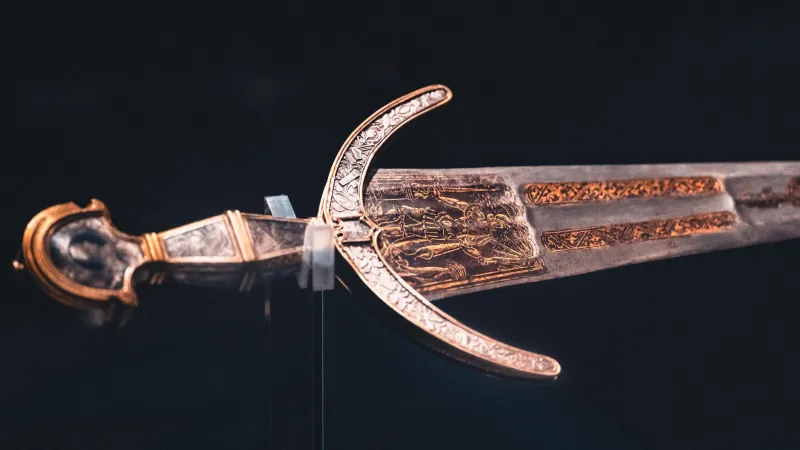
There is a peculiar comfort in a well-chosen quotation. It arrives fully formed, polished by history, carrying the authority of a name far greater than our own. Post it under a portrait of Marcus Aurelius, add a dark filter, and suddenly a half-considered opinion wears the armor of Stoic Rome. We have become a nation of people carrying swords we could never have forged ourselves.
The Armory of the Internet
Consider what our public arguments actually look like now. Someone challenges a belief we hold, and instead of reaching into our own reasoning, we reach for the rack: a Mark Twain zinger, a misattributed Einstein line, a Martin Luther King Jr. soundbite trimmed to fit a caption. These words are effective precisely because they are not ours. Who can argue with Twain? Who would dare cross swords with King?
But notice what has happened. In the moment we needed to defend a conviction, we produced someone else's. The blade gleamed, but our hands never touched the hilt. And a conviction held only by quotation is not a conviction at all—it is a costume.
Why We Hand Over the Sword
The motives are understandable, even honorable in origin. We sense that our own words are clumsy. We fear that our reasoning, laid bare, will not hold. So we borrow eloquence the way a nervous speaker borrows a podium—something solid to stand behind.
There is also a quieter dodge at work. If the borrowed words wound someone, the wound is technically not ours. The quote takes the blame; the famous dead take the responsibility. It is a way of cutting without bleeding, of arguing without fully arriving. We get to participate in the fight while remaining, in some flinching corner of ourselves, uncommitted.
What It Means to Wield an Idea
To actually hold a belief is different. It means you can say why you hold it in plain, unglamorous language—your language. It means you have sat with the objections, the ones that kept you up at night, and come out the other side either steadier or changed. It means that when your idea cuts someone, you do not hide behind the attribution. You accept that the cut came from you.
This is harder. A quotation is instant; understanding is slow. Anyone can repost Aurelius in eleven seconds. Very few can explain what Stoicism asks of them on an ordinary Tuesday in Ohio—when the commute is miserable, the coworker is cruel, and no inspirational meme is watching.
The Honor of Your Own Voice
There is a reason we named this place Honorable Swords. The sword in the ethical life is not aggression; it is the willingness to think for yourself and stand exposed by the result. Honor, in the old sense, was inseparable from ownership. A knight who fought with another man's blade under another man's banner was not honored—he was employed.
The great figures we quote would, almost uniformly, be horrified by our use of them. King did not inherit his convictions; he built them in the fire of study, prayer, and enormous personal risk. Aurelius wrote his meditations not for an audience but to talk himself into living his philosophy before breakfast. These were people wielding their own steel. We have turned their weapons into wall decorations.
Learning to Fight Our Own Arguments
The remedy is not to abandon the wisdom of the past—these voices deserve our attention. It is to move from quotation to conversation. Read the whole book, not the caption. Then close it and try, awkwardly, to say what you believe and why, out loud, to another human being who might disagree.
Expect it to be embarrassing at first. Your reasoning will creak. Your sentences will stumble. But a blade you have hammered yourself, however flawed, is yours to answer for. And there is a strange dignity in that exposure that no borrowed eloquence can supply.
The next time an argument finds you, resist the reflex to reach for the armory of the famous. Pick up the heavy, unpolished sword of your own thinking. Swing it honestly. And when it cuts—because it will—stand behind the cut as yours.


