Cruelty at a Distance, Kindness at a Loss: The Strange Arithmetic of Modern Speech
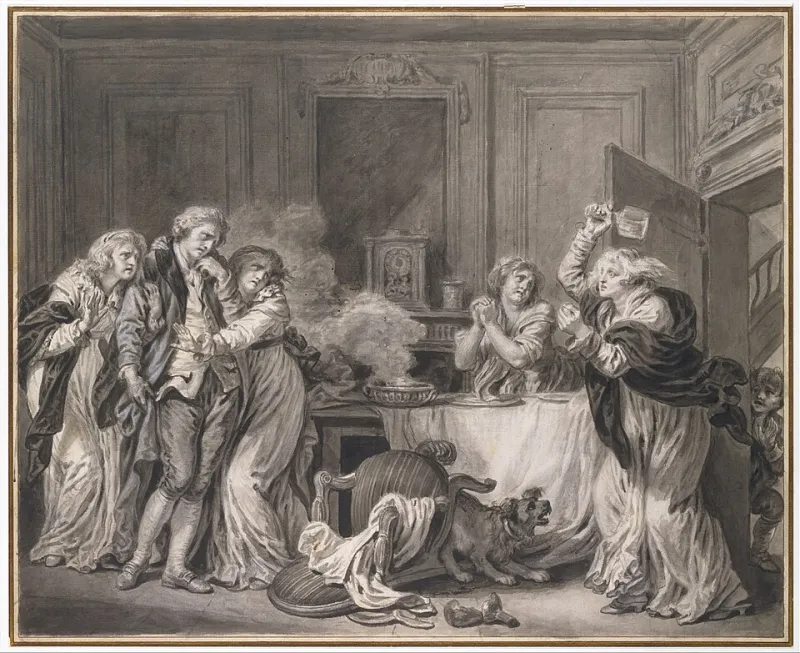
Photo: Jean-Baptiste Greuze, CC0, via Wikimedia Commons
There is a particular kind of person who exists only on the internet. You have met him. He types with the confidence of a Roman senator and the mercy of a hanging judge. He tells a stranger that her writing is worthless, that his opinions are embarrassing, that they should be ashamed of themselves. And then, perhaps an hour later, he stands in line at a grocery store in Ohio behind a cashier who just worked a double shift, and he says nothing at all. Not an unkind word — no word. Not a thank you with any weight behind it. Not a single observation that another human being did her job well while exhausted.
We tend to treat these as two separate behaviors. The first we call cruelty; the second we call shyness, or busyness, or simply nothing, because it leaves no trace. But the blade metaphor that gives this publication its name suggests otherwise. A knife kept sharp and used only for cutting down strangers is not a tool with a cruelty problem. It is a tool with a purpose problem. The edge exists. The hand is steady. What is missing is any commitment to using that edge for anything worthy.
The Inversion Nobody Planned
Consider how thoroughly we have inverted the natural order of speech. For most of human history, the closer someone stood to you, the more directly you spoke to them — and the more carefully, because you had to wake up tomorrow and see their face. Distance softened speech; it cost something to send a letter, so letters were written with care. Strangers received politeness not because we were better people but because the stakes of rudeness were visible and immediate.
The screen has severed the connection between cruelty and consequence. The stranger on the other side of a comment thread is not a person to us in any meaningful sense; they are a position, an avatar, a target. Meanwhile, the people physically in front of us — the barista, the coworker, the brother-in-law we see twice a year — have become almost invisible, precisely because they demand nothing from us. We have perfected the art of attacking people we will never meet and gone hollow at praising people we cannot avoid.
This is not merely bad manners. It is a moral failure with two halves that feed each other. The person who never practices sincere appreciation loses the muscle for it; appreciation atrophies into embarrassment. And the person who feels no warmth flowing outward finds an odd substitute flowing in: the cheap potency of outrage, which delivers the sensation of mattering without requiring the vulnerability of meaning it.
The Cowardice Hidden in Both
Notice what unites the online insult and the real-world silence: both are forms of cowardice wearing different clothes. The insult is cowardice because it never risks reply — the screen guarantees the aggressor can withdraw before any real confrontation occurs. The silence is cowardice because sincere praise is astonishingly vulnerable. To tell a colleague, plainly, that her handling of a difficult client was admirable is to expose something of yourself. It commits you. It can be received awkwardly. It cannot be taken back.
Cruelty from a distance and silence up close are, in other words, the same evasion pointed in two directions. We avoid the risk of honest encounter with the people in front of us and displace that avoided energy onto people who cannot look us in the eye. The ledger balances — but only in the way a fraudulent ledger balances, with the deficit simply moved to a different column.
The Practice of Honest Praise
What would it look like to correct this? Not forced positivity, which is its own dishonesty, and not the performance of niceness that this publication has elsewhere criticized as theater. The remedy is something stricter: a practice of honest praise.
The rules are simple. First, the praise must be specific — not "great job" but "the way you de-escalated that meeting saved the whole project." Specificity is what separates praise from flattery; it proves you were actually paying attention. Second, it must be delivered in person, or as close to in person as life allows, because the medium is part of the moral weight. Third, it must be true, and you must be able to defend it as true if questioned. A compliment you cannot substantiate is a coin you have debased.
Start with one a day. That is not a slogan; it is a training regimen, in the same way that daily push-ups are. The first week it will feel unnatural, even faintly embarrassing — Americans in particular are trained to deflect praise and, by extension, to withhold it. By the second week something interesting happens: you begin noticing competence, effort, and grace everywhere, because you have given yourself a reason to look. Attention, it turns out, follows the hand that acts on it.
And here is the part that surprises people: the practice quietly disarms the cruelty. It is difficult to spend your mornings sharpening genuine observation of other human beings and your afternoons reducing them to targets. The two habits draw from the same well of attention, and the well cannot serve both masters for long.
An Edge Worth Having
None of this requires abandoning critique. The world needs sharp tongues pointed at genuine injustice, and honest disagreement is a public good. But there is a difference between a blade kept sharp for worthy work and a blade kept sharp because cutting is the only thing we remember how to do.
The test is embarrassingly simple. When did you last tell someone, to their face, something true and good about themselves? If the answer is hard to recall, the problem is not that you are too harsh online. The problem is that your edge has only one setting. And an edge with one setting is not a blade at all. It is a habit with a handle.