Heat, Hammer, and Honesty: Why Real Accountability Cannot Be Poured Into a Mold
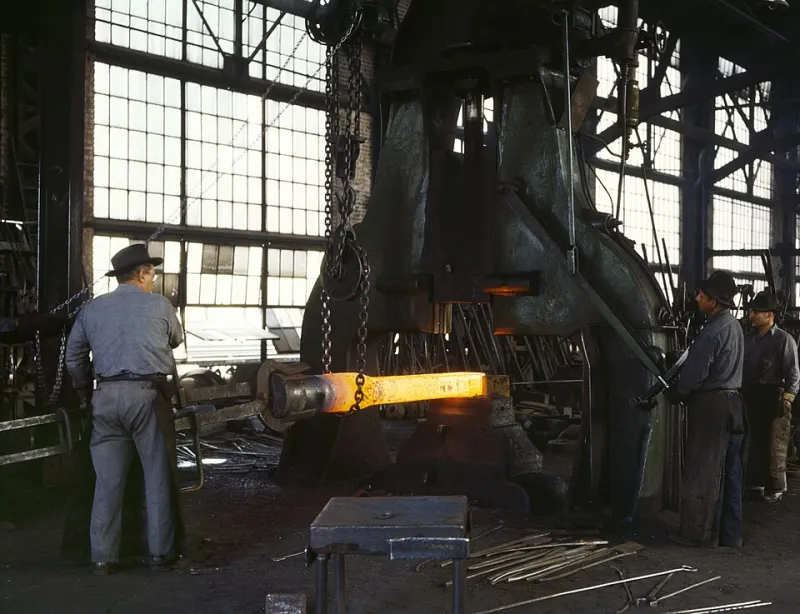
Photo: Jack Delano, Public domain, via Wikimedia Commons
There is a reason the great blades of history were not poured. A craftsman who simply liquefies steel and lets it harden in a mold produces something that looks finished—a smooth shape, a plausible edge. But strike it against anything real and it shatters. The metal never learned what it was made of.
The same could be said of most apologies exchanged in American offices, courtrooms, and living rooms this week. They were poured, not forged. They took the shape of the moment, hardened instantly, and broke the first time someone leaned on them.
What Forging Actually Requires
Watch a bladesmith at work and you will notice something counterintuitive: the making of a strong blade looks a great deal like the destruction of one. The steel is heated until it glows—uncomfortable, unrecognizable from its previous form. It is hammered, folded, hammered again. Each fold multiplies the layers. Each strike forces out impurities the smith would rather pretend were not there.
No honest smith skips the heat. No honest smith works cold steel.
Yet this is precisely what we demand of one another in moments of conflict. Say sorry, and we can move on. We ask for a cold, finished object—an artifact of accountability—rather than the slow, hot process that produces one. We want the blade without the forge.
The Heat of Genuine Conflict
Consider the last meaningful repair in your own life. Not the trivial ones—the forgotten birthdays, the missed calls—but the real ruptures. Almost certainly, the path back began with discomfort. A conversation you rehearsed in the car. A sentence you had to say out loud that you had only ever whispered to yourself.
That discomfort is not the obstacle to accountability. It is the raw material. An apology offered before anyone has felt the heat is not an apology; it is an anesthetic. It numbs the injured party and shields the offender from ever having to examine what the blade of their behavior actually did.
American culture, so fluent in the language of conflict avoidance, has nearly perfected the cold pour. The corporate statement released at 4:45 on a Friday. The apology that begins with "if"—if anyone was offended—and ends with a pivot to positivity. These are molds, mass-produced and interchangeable. They are designed to look like accountability while containing none of its temper.
Precision: The Specificity Test
The smith does not hammer randomly. Every blow lands where the metal needs to change. So it is with words that actually repair things.
A forged apology names the deed. It does not say "I'm sorry for how things went down"—a sentence so vague it could be stamped onto a thousand situations. It says: I dismissed your concern in the meeting. I did it because I was embarrassed, and I let my embarrassment become your humiliation.
Specificity is painful precisely because it is honest. Vagueness is a mercy we extend to ourselves. When we refuse to name exactly what we did, we are not sparing the other person's feelings; we are protecting our own self-image from the hammer. The blade that never gets struck in the right place never gets stronger.
The Cooling: Why Reflection Cannot Be Rushed
Here the metaphor sharpens. After the hammering, a blade must be tempered—held at heat, then cooled with control. Rush the cooling and the steel becomes brittle. Leave it soft and it will never hold an edge.
Accountability has the same thermal requirements. An apology delivered in the white heat of the moment often collapses into self-flagellation, which is its own form of self-absorption. But an apology deferred forever—cooled until it is inert—never cuts into anything. The repair requires time to reflect on why the harm happened, and time to change the conditions that made it possible.
Ask anyone who has waited months for a spouse, a sibling, a friend to truly come around: the silence between the rupture and the reckoning is not emptiness. It is tempering. And you can usually tell, when the words finally come, whether they were forged in that interval or simply reheated in a microwave of obligation.
The Quiet Test of the Finished Blade
There is a final humility in the smith's craft that we would do well to borrow. No blade is finished in the maker's hands. Its quality is proven only in use—in the strike it survives, the work it performs, the years it holds.
So it is with amends. An apology is not complete when it is spoken. It is complete when behavior bends to match it—when the person harmed can, over months, feel the shape of things changed. We have become a culture of excellent blades and terrible steel: polished words, displayed prominently, that snap under the first ordinary stress.
Perhaps the discipline we need is not better apology language. It is the smith's patience. The willingness to be heated. The precision to be struck where it counts. The restraint to cool slowly, and the character to be tested afterward.
Anyone can pour. Only the honest submit to the forge.