Whetstones, Not Wastebaskets: On the Vanishing Art of the Worthy Opponent
The Blacksmith's Paradox
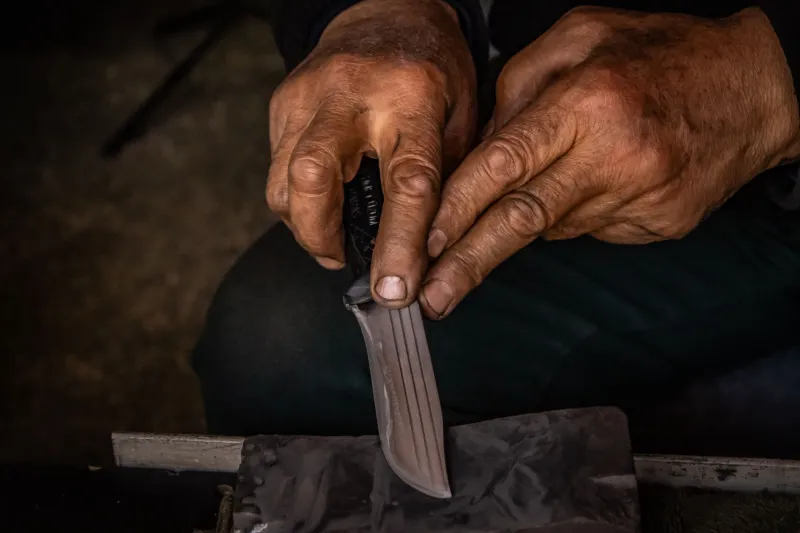
Every smith who has ever worked iron knows a truth that public life has forgotten: a blade does not become dangerous by avoiding the stone. It becomes dangerous — in the old sense, the useful sense, the sense that meant capable — by being drawn against resistance, again and again, until the edge reveals what the metal truly is. The whetstone does not hate the blade. The blade does not resent the stone. Together they make an edge that neither could produce alone.
We have lost this grammar. In our current civic vocabulary, the person who disagrees with us is not a whetstone. They are waste — to be blocked, ratioed, dismissed, or, in the softer register of polite society, politely never engaged. We file our opponents not under rivals but under refuse. And like any blade locked in a drawer, our convictions have not been preserved by the absence of friction. They have quietly corroded.
Lincoln's Terrible Gift
Consider the strangest cabinet in American history. When Abraham Lincoln assembled his administration in 1861, he did not surround himself with admirers. He appointed William Seward, his fiercest rival for the nomination; Salmon Chase, who thought himself the better man and schemed accordingly; Edward Bates, a conservative who distrusted nearly everything Lincoln stood for. Seward had predicted the presidency for himself and was stunned to lose it to a prairie lawyer.
Lincoln's reasoning was not sentimental. He did not gather these men because harmony is pleasant. He gathered them because a president insulated from first-rate opposition becomes a second-rate thinker. Seward's ambition, Chase's moral severity, Bates's caution — these were not liabilities to be managed. They were pressures against which Lincoln's own judgment could be tested and refined. Historians still debate how many of his finest decisions were forged in the friction of that room. The Emancipation Proclamation, argued about, resisted, and revised within that cabinet, emerged sharper for the argument.
This is not a story about tolerance. It is a story about craftsmanship. Lincoln treated his adversaries the way a smith treats a whetstone: as instruments without which no honest edge is possible.
What the Stoics Knew About the Difficult Man
The Stoics arrived at the same insight from another direction. Marcus Aurelius, who had every reason to resent the courtiers and incompetents surrounding him, began each morning with a discipline he recorded in his private notebooks: today I will meet the interfering, the ungrateful, the arrogant. Not today I will defeat them. Not today I will avoid them. Today I will meet them — and their interference will be the occasion for practicing patience, their arrogance the whetstone for humility.
Seneca put it more bluntly. The person who wrongs you, he suggested, is doing something for you that your friends cannot: revealing exactly where your philosophy is still soft. A conviction that has never been genuinely challenged is not a conviction. It is an heirloom you have not yet dropped.
The Economics of the Disposable Enemy
Something in our culture has inverted this ancient arithmetic. The platforms where millions of Americans now conduct their civic lives are engineered — not by accident, but by design — to make opposition frictionless and engagement optional. The block button, the mute, the unfollow: these are the wastebaskets of the digital age. They promise us an edge without a stone.
The result is a peculiar moral atrophy. Watch any online argument and notice how rarely it produces the thing arguments once produced: a sharpened position, a conceded point, a refined understanding. Instead, opposition is performed for an audience of the already-convinced. The opponent is not engaged but exhibited — a specimen held up for ridicule, never once taken seriously enough to be answered.
There is a word for a blade that is displayed but never drawn against the stone: ornamental. And there is a word for a conviction held the same way: sentimental. Much of what passes for passionate belief in American life today is ornament. It has never been tested because its holder has never permitted a test. It is kept sharp-looking by proximity to those who agree, the way a knife in a drawer stays shiny — unused, untested, and quietly duller than its owner knows.
The Discipline of Honest Opposition
What would it mean to recover the whetstone? It would begin with a distinction our culture has erased: the difference between an adversary and an enemy. An adversary is someone whose opposition has function — who forces us to discover which of our beliefs can survive contact with a serious mind. An enemy is someone whose opposition has no function except to confirm what we already believed. The first is an instrument. The second is a mirror, and a flattering one.
Honest engagement with an adversary requires three disciplines, all of them uncomfortable.
First, steel-man before you strike. State your opponent's position so fairly that they would recognize it as their own — and improve it where you can. If your summary of their view is weaker than their view, you have not yet engaged them. You have engaged a scarecrow wearing their name.
Second, let the stone mark you. The purpose of opposition is not to demonstrate your edge but to discover its flaws. If you emerge from every disagreement unchanged, you were never sharpening. You were polishing.
Third, keep the person larger than the position. Lincoln disagreed with Chase on nearly everything and removed him from the cabinet — then appointed him Chief Justice of the Supreme Court, saying he had found Chase a great man and the office a great office, and that they should be brought together. To disagree without dehumanizing is not weakness. It is the precondition for ever being corrected.
An Edge Worth Keeping
None of this guarantees civility, and civility is not the point. Lincoln's cabinet argued savagely. The Stoics were not gentle with themselves. The whetstone's gift is not comfort; it is keenness. A civic culture that silences, mocks, and discards its opposition is not a peaceful culture. It is a dull one — armed with blades no one has tested, held by hands that have never learned the weight of a real argument.
The smith does not thank the stone for being gentle. The stone is not gentle. But the smith knows what the stone is for, and so keeps it close, and so keeps the edge. We might do worse than to look at the people who most challenge us and ask, honestly, whether they are wastebaskets — or whether they are the very stone our convictions have been waiting for.